Environment Class 18
THE CLASS STARTED WITH A BRIEF OVERVIEW OF THE PREVIOUS TOPICS (05:14 PM)
TIMELINE OF VARIOUS DEVELOPMENTS/INITIATIVES (05:13 PM)
- 1987: Brundtland Report: Title- 'Our Common Future' was published.
- It mentioned about the Sustainable development.
- 1988: In this year the IPCC Came into existence.
- 1989: Basel Convention came into existence.
- It is the convention to control the 'Transboundary movement of hazardous waste'
- Prior consent approval regulates any kind of transboundary movement of hazardous waste.
- It doesn't cover the radioactive waste.
- 1992: Rio Earth Summit, During this summit following developments came up:
- UNFCCC
- UNCCD
- UNCBD
- 1997: Kyoto Protocol.
- 1998: Rotterdam Convention:
- It is an international convention covering the trade of hazardous chemicals.
- It aims to facilitate information exchange and provides for decision-making during the import of hazardous chemicals and it covers those pesticides and industrial chemicals that are banned or restricted.
- It follows the Prior Informed Consent Procedure, and it is legally binding.
- 2000: Cartegena Protocol:
- It is protocol on Biosafety.
- It is part of UNCBD
- 2001: Stockholm Convention:
- It came in order to regulate the compounds which are 'Persistent Organic Pollutants'.
- POPs are organic compounds that are resistant to degradation, they are capable of long-range transfer, bioaccumulation and biomagnification.
- It released a list of 12 POPs, known as 'Dirty Dozen' to be phased out.
- Pesticides like 'DDT' as well as 'Endrin' were among them.
- 2002: Johannesburg Conference (Rio+10 Conference)
- 2012: Rio Conference (Rio+20 Summit)
- 2013: Minamata Convention:
- It aims to protect human health and the environment from anthropogenic emissions of Mercury.
- It aims to reduce mercury pollution from targeted activities.
- 2015: Paris Agreement.
INITIATIVES TO MITIGATE CLIMATE CHANGE (05:44 PM)
- 1988: IPCC was established to check the extent of climate change.
- IPCC was established jointly by UNEP and WMO to provide scientific information to develop climate policies.
- IPCC releases 'Assessment Reports(AR)'
- AR1 came in 1990, In this report IPCC said that climate change is happening along it also mentioned that around 95% cause of climate change is human-induced activities.
- The latest report is AR6(2021-22).
- It was awarded the Nobel Peace Prize in 2007.
- The longest-serving Chairperson of IPCC was Indian R.K. Pachauri.
- 1992: Rio Earth Summit.
- 1994: UNFCCC came into force.
- The parties to UNFCCC are categorized into 4 groups:
-
OECD Countries (Annex-1 Countries) Economies in Transition (Second World) (Annex-1 Countries) Developing Countries (Non Annex-1 Countries) Less Developed Countries Mostly Developed Countries These countries were in need of some support for climate change mitigation efforts The Non-Annex countries don't have specific targets to achieve in terms of emissions reductions, etc. The Non-Annex countries don't have specific targets to achieve in terms of emissions reductions, etc The Annex-1 countries will have some targets to achieve in terms of emissions reductions, etc. The Annex-1 countries will have some targets to achieve in terms of emissions reductions, etc. . Later on, these are called Annex II Countries. - 1995: COP 1 was held in Berlin.
- 1997: COP 3 held in Kyoto.
- Kroto Protocol came into existence in this COP.
- Kyoto Protocol:
- The GHGs were targeted like HFC, and PF6 to be reduced.
- Annex-I countries to have specific targets.
- No Specific targets for non-annex countries.
- It came into force in 2005, and five years of commitment targets were given.
- Emission Reduction Targets were given to each of the Annex-I Countries.
- Kroto Mechanisms also known as Flexible mechanisms like:
- 1) Joint Implementation:
- Where two Annex-I countries invest together in emission reduction projects.
- 2) Clean Development Mechanisms:
- It involves Annex-I countries meeting their emission targets through projects in Non-Annex-I countries.
- 3) Emission Trading:
- It involves the trading of Kyoto units between different countries.
- Kyoto units refer to the amount of carbon dioxide reduced.
- COP 8 New Delhi:
- It was held in New Delhi and adopted the Delhi Ministerial Declaration.
- The Delhi Ministerial Declaration was about technological transfer to developing countries.
- COP 15: Copenhegan:
- It was held in 2009, (Copenhagen)
- The Annex-I countries were completely reluctant to fulfil the targets under the Kyoto Protocol.
- COP 16 Cancun:
- It agreed on the establishment of the Green Fund as an aid from the developed countries for developing countries.
- Green Climate Fund: It aims to transfer 100 Billion dollars by 2020.
- COP 17 Durban:
- Green Climate Fund was established.
- COP 18 Doha:
- The Kyoto Protocol was extended till 2020.
- COP 21 Paris Agreement:
- The central objective is to hold the increase in the global average temperature well below 2 degrees Celsius above pre-industrial levels and to pursue efforts to limit the temperature increase to 1.5 degrees Celsius.
- NDCs are the commitment of the members to reduce emissions to limit global warming.
- A mechanism of 'Global Stocktake' (GST) was agreed to evaluate the performance of members.
- It was agreed to conduct GST once in 5 years and to participate in GST is legally binding.
- It entered into force in 2016 but the first meeting (CMA-1) was held in (Katowice) 2018.
- NDCs of India:
-
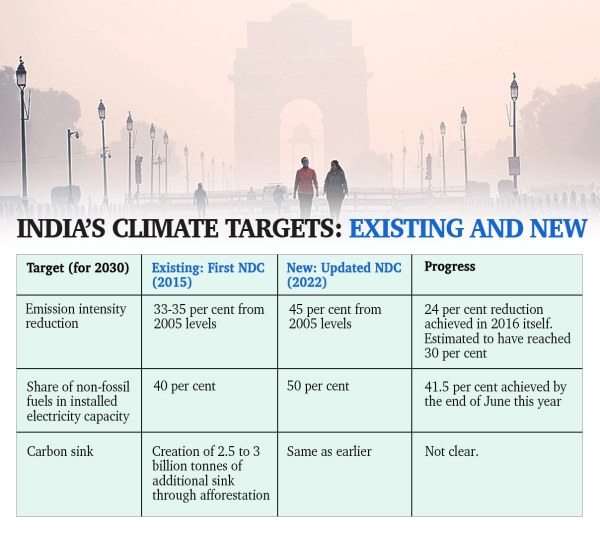
- In the Paris Agreement the NDCs need to record the NDCs in a Public Registry.
- Members shall have a common timeframe for NDCs.
- COP 26 Glasgow:
- More than 140 countries agreed to achieve 'Net Zero Status'
- Most of the developed countries to achieve it by 2050, china by 2060 and India by 2070.
- Members agreed to phase down the coal and Phase out inefficient fossil fuels.
- 'Glassgow Breakthrough Agenda' to accelerate the development and deployment of clean technology.
- COP 27 Sharm el-Sheikh:
- Discussions on Adaptation and Mitigation.
- A new funding arrangement was agreed upon for 'Loss and damage' to assist developing countries that are vulnerable to adverse effects of climate change.
- The Countries discussed on just transition in the efforts to reduce emissions and to move away from polluting sources.
- COP 28 Dubai:
- An agreement that signals the “beginning of the end” of the fossil fuel era by laying the ground for a swift, just and equitable transition, underpinned by deep emissions cuts and scaled-up finance.
WILDLIFE: SNOW LEOPARD (07:28 PM)
-
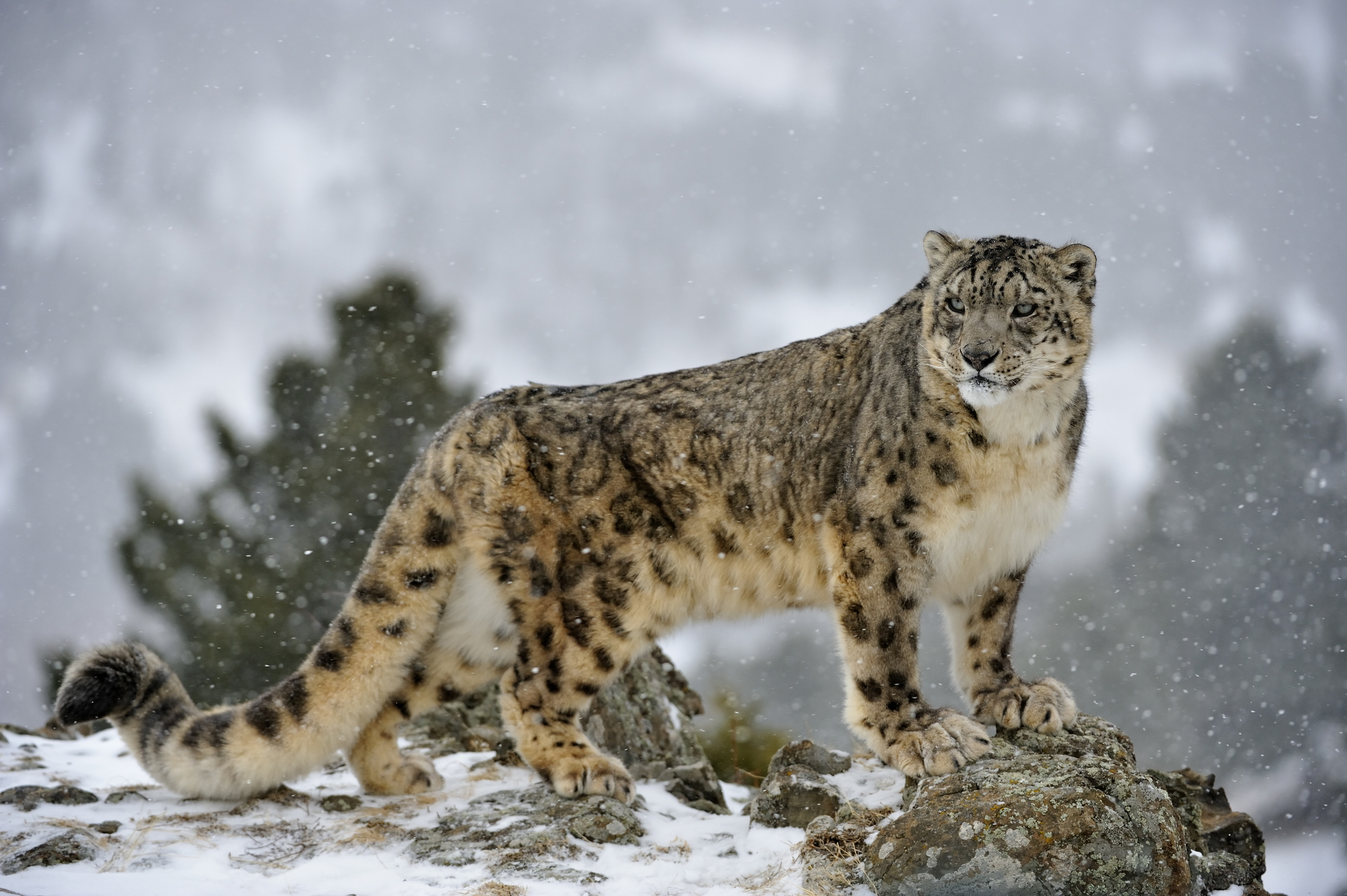
- They are called as 'Ghost of the Mountains'
- Snow leopards are found in the high-altitude mountainous regions of Central Asia, including the Himalayas.
- They inhabit rugged terrains at elevations ranging from 3,000 to 4,500 meters.
- There is an estimate that around 6000-7000 Snow leopards.
- IUCN Status: Vulnerable.
- Snow Leopards have the heavier tail.
- Snow leopards primarily prey on Ibex, Mountain goats, and other small mammals.
- Snow leopards have strong, stocky bodies adapted for climbing and navigating steep, rocky slopes.
- Their large, fur-covered paws act like natural snowshoes, providing insulation and traction in snowy environments
- It is observed in a total of 12 Countries (Bhutan, Nepal, India, China, Pakistan, Afghanistan, Kyrgyzstan, Uzbekistan, Kazakhstan, Tajikistan, Mongolia, Russia)
- In India, It is observed in Jammu Kashmir, Ladakh, Uttarakhand, etc
- Conservation Efforts:
- Project Snow Leopard:
- It was initiated in the year 2009.
- It is a centrally sponsored scheme.
- Save Our Snow Leopards (SOS):
- It is implemented by the WWF.
- Global Snow Leopard and Ecosystem Protection Programme (GSLEP):
- This is an international alliance.
- The 12 snow leopard countries are members of this.
WILDLIFE: CLOUDED LEOPARD (07:42 PM)
-

- IUCN Status: Vulnerable.
- They are usually found in tropical evergreen forests.
- Found mainly in North East Forests.
- It is often described as an elusive and enigmatic animal due to its secretive nature and the remote, challenging environments in which it resides.
- It is state animal of Meghalaya.
WILDLIFE: FISHING CAT (07:44 PM)
-
- IUCN Status: Vulnerable.
- It is found near Wetlands and Water bodies.
- They swim and hunt the fish.
- It is found in Sundarban, Mahanadi Delta, and Some parts of Western Ghats.
- It is 'nocturnal' in nature.
- It is a state animal of the West Bengal.

WILDLIFE: ELEPHANT (07:47 PM)
-

- Elephants are called as 'Ecosystem Engineers'
- IUCN Status: Endangered
- It is a highly emotional and intelligent species.
- They have strong bonds among themselves they follow matriarchy.
- Usually male elephants live alone.
- Average Age: around 100-120 years.
- They have the longest gestation period.
- They are capable of travel very long distances.
- There are three known species of Elephants:
- 1) African Savanna Elephant
- 2) African Forest Elephant
- 3) Asiatic Elephant
- India have around 27,000 elephansts.
- Karnataka has the highest then Assam, Kerala, etc.
- Conservation Initiatives/efforts:
- Project Elephant:
- It is centrally sponsored scheme.
- Objectives:
- To ensure a viable population of elephants in their natural habitat.
- To reduce man-elephant conflict.
- To protect elephants from poaching and hunting and to ensure the welfare of captive elephants.
- There are 32 Elephant reserves in India and 10 Elephant landscapes.
- International Efforts:
- Monitoring Illegal Killing of Elephants (MIKE)
- It was started in 2003 with the help of CITES.
- Elephant is India's national heritage animal.
- Differences among the Elephants:
-
African Savanna Elephant
African Forest Elephant Asiatic Elephant Tallest Elephant among these Smallest elephant species Tallest at the arch of back Large ears Darker in colour Small ears Back dips in the middle Rounder ears and smaller mandible The single lobe on the tip of the trunk Tusks curve upward and grow outward or away. Found in dense forests Two bulbous bump of the forehead
WILDLIFE: ONE HORN RHINO (08:04 PM)
-
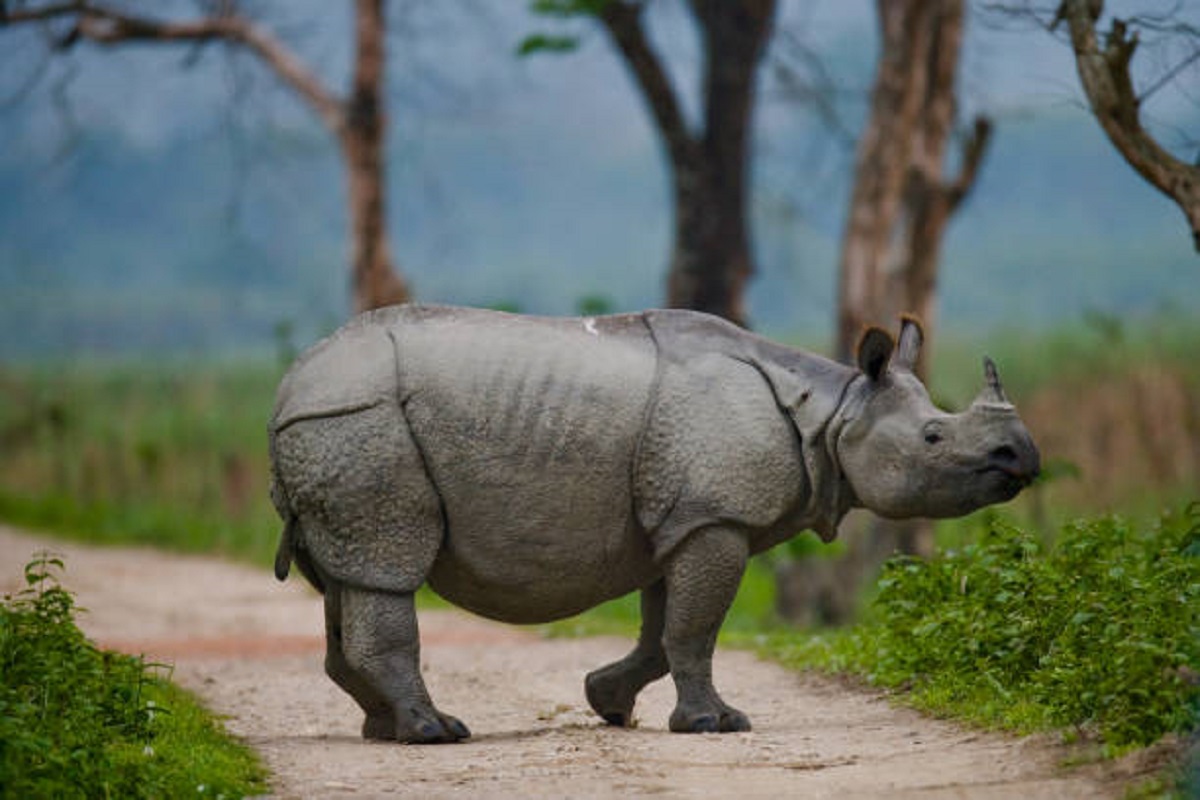
- IUCN Status: Vulnerable.
- Efforts:
- Indian Rhino Vision 2020:
- It was implemented by Govt. of Assam and WWF.
- It was started in the year 2005.
- Objective:
- To increase the Rhino population from 2000 to 3000.
- Natural Habitat:
- Entire Indo-Gangetic plain.
- It is present in almost 90% of Assam(Pobitora, Kaziranga and Manas National Park) and the rest in West Bengal, Bihar and U.P.
WILDLIFE: GREAT INDIAN BUSTARD (08:12 PM)
-
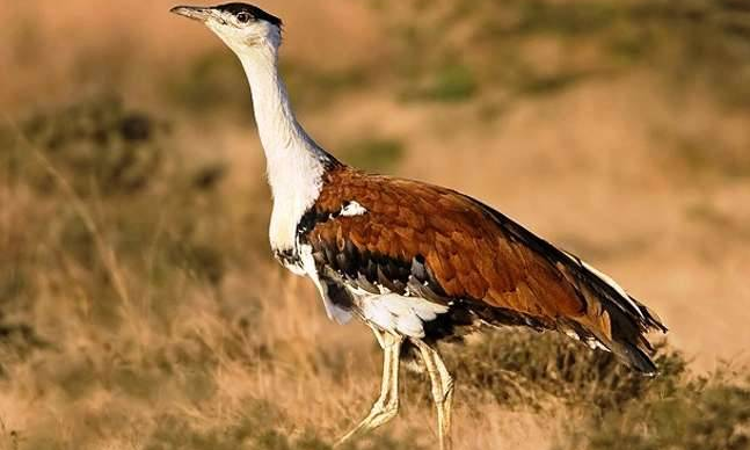
- It is heaviest flying bird endemic to Indian subcontinent.
- Grassland Ecosystem
- IUCN Status: Critically Endangered.
- Protected as Schedule-I in WPA.
- It shares the habitat with Cheetahs and Blackbuck.
- Reasons for its declining population:
- Poaching for Meat
- Habitat degradation.
- Collision with electric wires.
- Areas: Rajasthan, Some parts of Maharashtra, etc
- Conservation Efforts:
- Integrated Development of Habitat.
- GIB protection zones are declared.
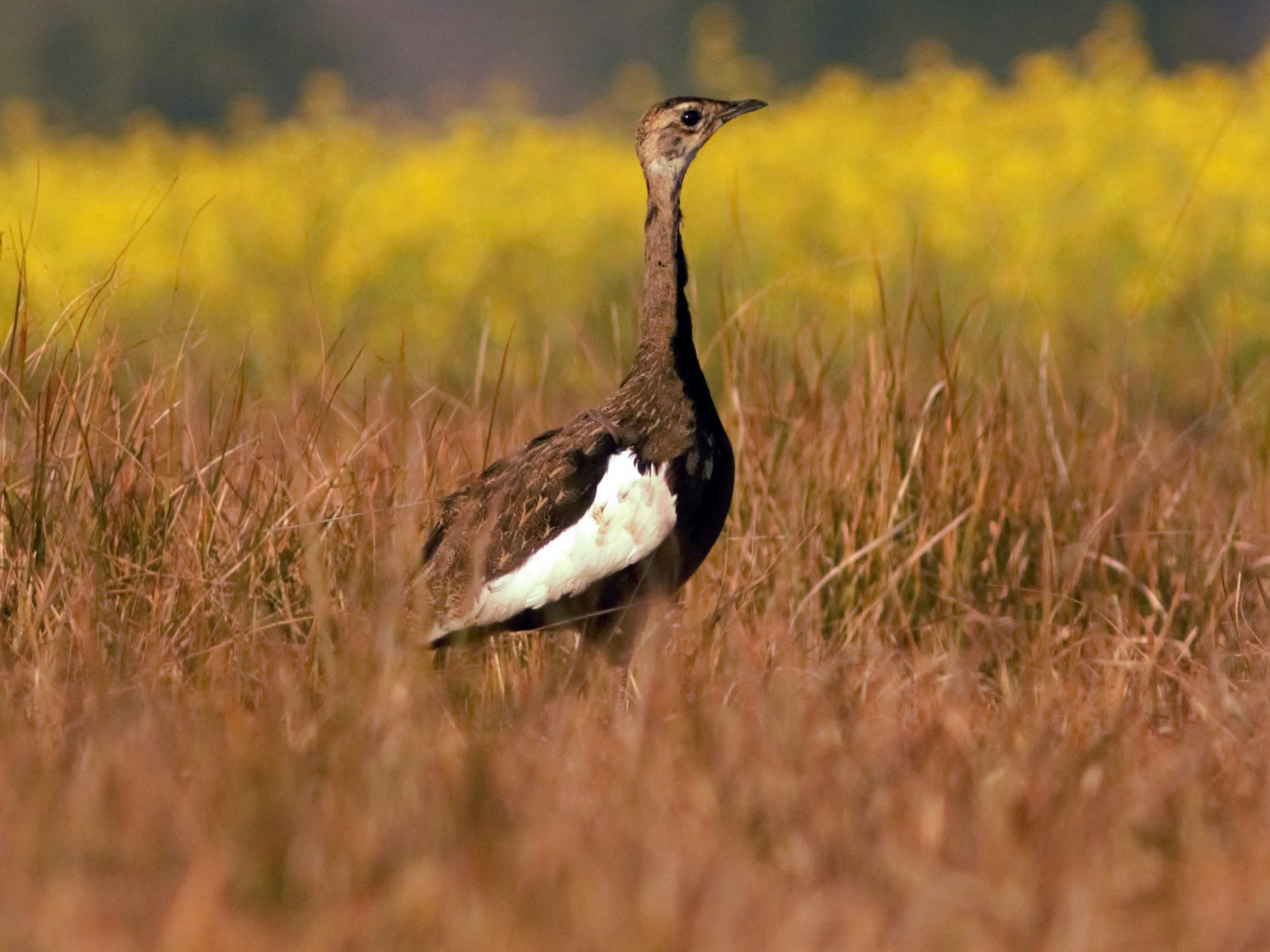
- Bengal Florican:
-
- It is found in Bengal and Assam marshy lands.
- Lesser Florican
-
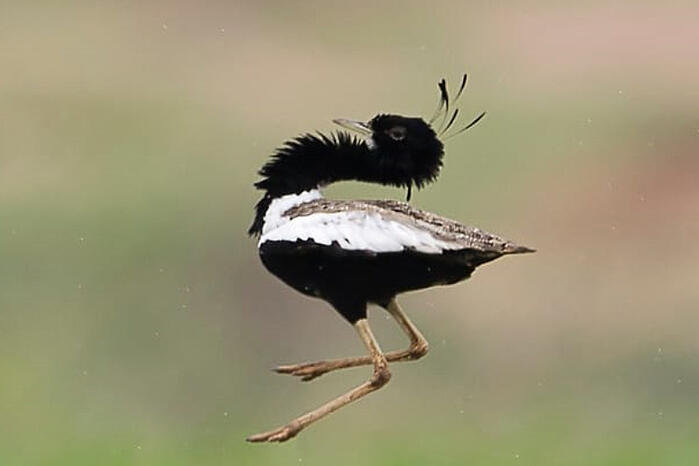
- The preferred habitat is grasslands.
TOPIC FOR THE NEXT CLASS: UNCBD, UNCCD, SUSTAINABLE DEVELOPMENT, ETC.